TSCM & Debugging
People usually call us with the same question, worded two ways. The first time it is how do I get my office swept. The second time, a few months later, it is how often should I be doing this. The second question is the better one.
Like what you read? Show me more from NYIA on Google, then pick us as a preferred source.
What’s Inside
8 sections
A bug sweep tells you the truth about one place at one moment. It does not stop anyone from walking back in the next morning. So the real answer is not a number. It is a schedule that matches your risk, plus a short list of events that should move the schedule up.
The short answer
- High risk rooms, such as a boardroom, a legal war room, or an executive office, get swept every three months.
- Most businesses with anything worth stealing get swept twice a year.
- A normal office with low exposure gets swept once a year, as a baseline.
- A private home is usually event driven. You sweep when something changes, not on a calendar.
- Anyone in active litigation, a divorce, or a deal gets swept at the start and again before the end.
If you only remember one line from this page, make it this one. A sweep protects the period right after it, and nothing before it.
Events that should trigger a sweep this week
Calendars are useful. Events matter more. Call when any of these happen, no matter when the last sweep was.
- A lawsuit is filed, by you or against you.
- A divorce starts, or one side moves out of the house.
- A merger, a sale, or a funding round goes into diligence.
- Something private shows up somewhere it should not, such as a quote from a closed meeting.
- A senior person leaves, especially if they left angry.
- You take a new office, a new suite, or a short term rental.
- Contractors, cleaners, or repair crews had unescorted access.
- A negotiation is about to start and the other side keeps guessing right.
- You are being followed, or someone knows where you were.
- A gift arrives that plugs in, especially a clock, a charger, a speaker, or a lamp.
Why one sweep is never the whole answer
Two reasons, and both are simple.
The first is access. Most devices we find were not planted by a professional. They were planted by someone who already had a key, a badge, or an invitation. That person still has it the day after the sweep.
The second is that the hardware keeps getting cheaper. A recording device that used to cost real money and take skill to hide now arrives in a box, runs for weeks on a battery, and looks like a power strip. Price used to limit this work. It does not anymore.
What a sweep actually covers
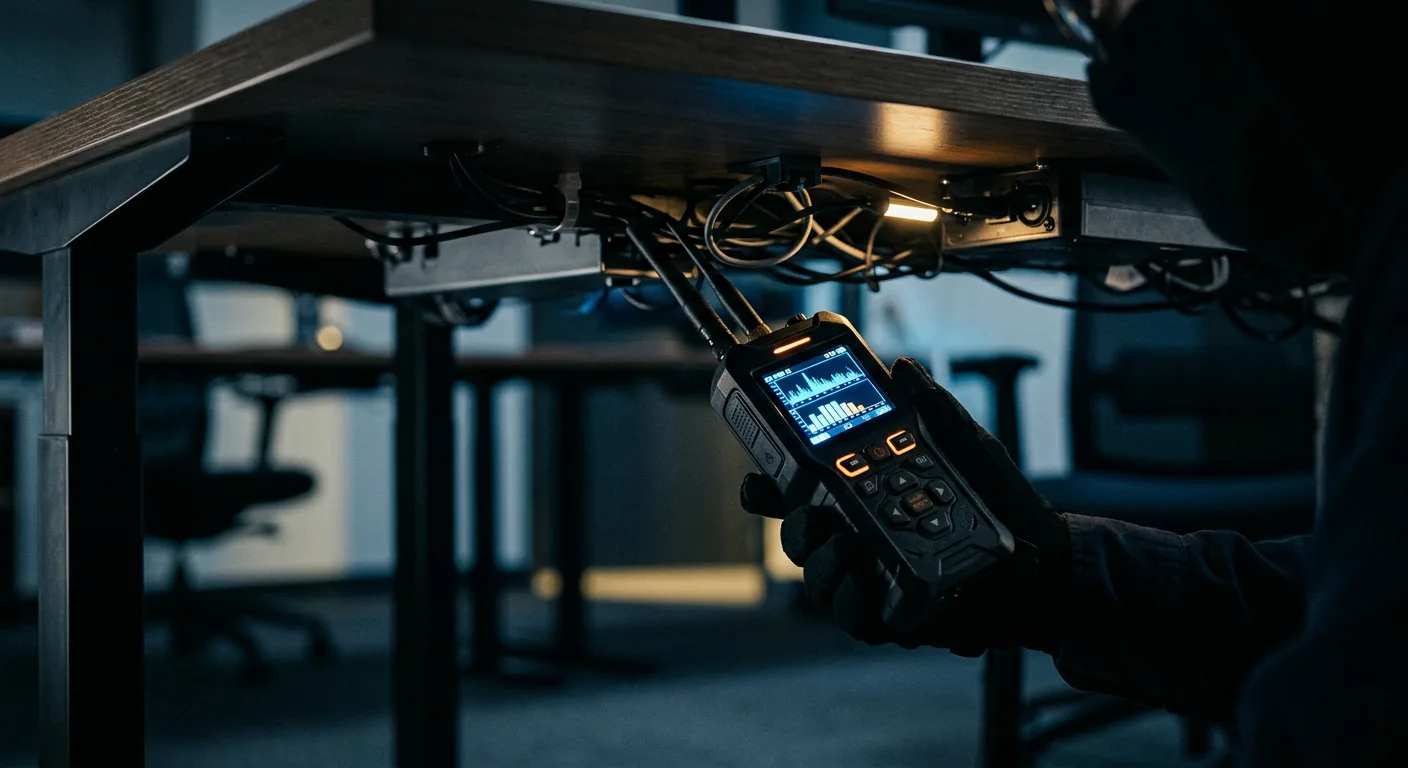
A real bug sweep is a physical search backed by instruments, not a walk around with a handheld detector from a website. Ours covers the room, the wiring, and the network.
- A hands on inspection of furniture, fixtures, vents, outlets, and anything that was recently moved or delivered.
- Radio frequency analysis to find transmitters that are sending right now.
- Non linear junction detection, which finds electronics that are switched off or out of battery.
- Thermal imaging to spot devices drawing power inside a wall or a fixture.
- Phone and cable line checks, including the closet nobody has opened in years.
- Wi Fi and network review for cameras and recorders quietly using your own connection.
- A written report you can hand to a lawyer or an insurer.
The full walkthrough is here: how TSCM experts conduct a bug sweep, step by step.
What to do between sweeps
Most of this costs nothing and it closes the easy doors.
- Escort every visitor, including the ones you know. Especially the ones you know.
- Keep a log of who had access to sensitive rooms and when.
- Do not hold the most sensitive conversation in the most obvious room.
- Check anything new that plugs in before you plug it in.
- Look at your own Wi Fi device list once a month and question anything you cannot name.
- Change locks and access codes when someone leaves, not a month later.
- Photograph a clean room after a sweep. Next time, you can compare.
The law, in plain words
You are allowed to sweep space you own or control. That part is easy.
The other side is not. In New York, recording a conversation you are not part of is eavesdropping, and eavesdropping is a class E felony. Planting a camera to record someone in a place where they expect privacy is unlawful surveillance, which is also a felony. You may record a conversation you are actually part of, because New York only requires the consent of one party. That is the line, and it is narrower than most people assume.
If we find something, we document it in place first. Pulling a device out of the wall feels good and destroys the evidence that would have told you who put it there.
Common questions
How long does a bug sweep take?
Plan on two to four hours for a normal office or apartment, and a full day for a floor, a large home, or a site with a lot of wiring. Rushing a sweep is the one way to guarantee a bad result, so we would rather book the time than cut it short.
Will the person who planted it know I swept?
Not if the sweep is arranged properly. We schedule outside normal hours where it helps, we arrive without markings, and we do not announce the work to staff. If the room is being watched, how you book the sweep matters as much as the sweep itself.
What happens if you actually find something?
We stop and document it exactly where it sits, with photographs and time stamps, before anything is touched. Then we talk through your options, which usually means police, a lawyer, or a controlled removal. The device is often the only thing that leads back to the person who placed it.
How often should you get a TSCM sweep?
It depends on risk. Our guide suggests every three months for boardrooms and legal war rooms, twice a year for businesses with valuable secrets, and once a year for a low risk office. A home is usually swept after an event, like a divorce or a lawsuit. A sweep protects the time after it.
If you are trying to pick a date
Pick the next thing on your calendar that would hurt if it leaked, and sweep before it. That single rule gets most people to roughly the right frequency without a spreadsheet. Call David at (646) 461-4650 for a free and confidential conversation, any hour, any day. If your risk does not justify a sweep yet, we will tell you that too.
Official sources you can check yourself
We would rather you check this than take our word for it. These are the primary sources behind the guidance on this page.
- New York Penal Law 250.05, eavesdropping. The section that makes wiretapping and planted listening devices a class E felony.
- New York Penal Law 250.45, unlawful surveillance in the second degree. The video side of the same problem, also a felony.
- New York Penal Law 250.00, definitions. This is where the one party consent rule for recording actually lives.
- New York Department of State license search. Check any New York investigator by name or license number before you hire. Ours is #11000169770.
- New York Emmy® Awards, 2008 winners list. The National Academy of Television Arts and Sciences, New York chapter, lists David J. Schassler as Lead Researcher on the Emmy winning WCBS TV report “Red Light Rabbi.”
Whatever you are facing, NYIA can help you find the truth. Our private investigator team runs TSCM bug sweeps across New York City, Westchester, Rockland, and Long Island. Contact us for a free and confidential consultation at (646) 461-4650.
Thank you. That helps.
Your answer went straight to our office. If you left an email, expect a real reply from a person, not a mailing list. If you would rather talk it through now, call (646) 461-4650 or text (646) 465-2006. The first conversation is free and confidential.

David J. Schassler
Emmy® Award Winning Private Investigator · NYS DOS License #11000169770
David founded New York Intelligence Agency in 1989 and has personally directed every major case since. His investigative work earned a New York Emmy® Award. More posts by David →
Free, Confidential Consultation
When you need answers,