TSCM
To find hidden cameras and listening devices, turn off the lights and sweep the room with a flashlight for lens glints. Check smoke detectors, chargers, clocks and outlets near where you talk or sleep. Look for devices you do not own on your Wi-Fi and Bluetooth lists, and use your phone camera to spot infrared lights. A phone can catch some cameras. It misses most audio bugs. When the stakes are high, a professional bug sweep finds what these checks cannot.
We have been sweeping New York homes, offices, cars and boardrooms since 1989. Most of the guides that rank for this topic are written by companies that sell cameras or detector apps. This one is written by the people who get called after the app said “all clear.”
Here is the honest version. What you can check tonight with a phone and a flashlight. What your phone will never find. And what to do the minute you find something.
The 10 minute check
- Kill the lights. Sweep the room slowly with a flashlight at eye level. A camera lens throws back a tiny pinpoint of light.
- Look through your phone camera in the dark for small purple or white dots. Those are infrared night vision lights.
- Open your Bluetooth settings and look for device names you do not recognize.
- Run a free Wi-Fi scanner app and list every device on your network.
- Check the smoke detector, clocks, chargers and power strips closest to your bed, your couch and your desk.
- Ask one question: does someone know things they should not? That is the strongest sign there is.
What Hidden Listening Devices Actually Look Like Now
Forget the movie bug taped under a table. Today a hidden listening device is usually a normal object with a microphone inside it. A USB wall charger. A power strip. A smoke detector. A pen. A key fob. A clock radio. Some are cameras that also record sound.
What matters is not what it looks like. It is how it gets your words out of the room. That decides whether you can find it, and what you need to find it.
| Device type | How it sends what it hears | Can your phone find it? |
|---|---|---|
| Voice activated recorder | It does not. It saves audio to a memory card. Someone comes back for it. | No. It gives off no signal at all. |
| Cellular (GSM) bug | A SIM card inside. The person calls it and listens live from anywhere. | No. It only transmits during a call, and looks like any other phone signal. |
| Wi-Fi camera or mic | Streams over a Wi-Fi network to an app. | Sometimes, if it is on your network. Not if it runs its own hotspot. |
| Bluetooth bug | Short range. Someone nearby connects to it. | Sometimes, if it shows up in your Bluetooth list. |
| Night vision camera | Any of the above. Uses infrared lights to see in the dark. | Often. Your phone camera can see the infrared glow. |
| Spyware on your phone | Your own phone is the microphone. It uploads to the person who installed it. | Sometimes. See the phone check below. |
What a phone can catch
Voice activated recorderNo
Cellular (GSM) bugNo
Bluetooth bugSometimes
Wi-Fi camera or micSometimes
Spyware on your phoneSometimes
Night vision cameraOften
How to Detect Hidden Listening Devices With Your Phone
Your phone is a decent first tool. It works on both iPhone and Android. Do these in order.
1. Test your camera first
Not every phone camera can see infrared. Point a TV remote at your phone camera and press any button. If you see the little light flash on your screen, that camera works for this. If you see nothing, switch to the other camera and try again. On many phones the front camera works better.
2. Do the lights off infrared sweep
Turn off every light and close the blinds. Open the camera that passed the remote test. Move slowly around the room and look at the screen, not the room. A night vision camera shows up as one or more small glowing dots, usually purple or white. Pay attention to anything aimed at the bed, the shower, the couch or your desk.
3. Read your Bluetooth list
Open Bluetooth settings and let it search for a full minute. Write down every name. Most will be yours or your neighbors’. Look for odd names, strings of random letters, or anything that gets stronger as you walk toward one spot.
4. Scan your Wi-Fi network, then flip the breakers
Install a network scanner like Fing and run a scan. It lists every device on your Wi-Fi with a maker name. Look for camera brands you never bought, or devices with no name at all.
Then try the breaker trick. Turn off the power to one room at the breaker box and scan again. Anything that drops off the list was plugged in, or wired in, inside that room. Now you know where to look.
One limit. A camera planted by someone who does not know your Wi-Fi password will not be on your network. It will use its own hotspot or a SIM card. So a clean scan is good news, not proof.
5. Check for trackers
Hidden cameras and bugs often come with a GPS tracker on the car or in a bag. iPhones alert you on their own when an unknown AirTag or similar tracker travels with you. On most Android phones you can scan by hand. Look under Settings, then Safety and emergency, then Unknown tracker alerts.
6. Check the phone itself
This is the one most people skip. In a home, the easiest bug to plant is the phone you already carry. If someone has had your phone and your passcode, check it.
- iPhone: go to Settings, then Privacy and Security, then Safety Check. It shows who you share your location and data with, and lets you cut them off.
- Android: look at your list of apps for anything you did not install, and check Device admin apps under Security settings.
- Both: sign out of your Google or Apple account on every device you do not recognize, and change the password.
7. Check your smart home
Smart speakers, video doorbells and indoor cameras you own can be turned against you by anyone who still has the login. Open each app. Look at who is on the account and which phones are signed in. Turn off features like Drop In on Alexa if you do not use them.
What phone apps cannot do
Most free “bug detector” apps read your phone’s compass sensor. It reacts to any metal, magnet or speaker. It will beep at your fridge. Your phone also has no way to scan the radio frequencies a real bug uses. Treat these apps as a toy, not a test.
Where Hidden Cameras and Bugs Get Placed, Room by Room
A bug has to be close enough to hear you, and most need power for weeks. A camera needs a clear view. That narrows the search a lot. Start where private things happen.

| Room | Check these first |
|---|---|
| Bedroom | Smoke detector, alarm clock, lamp, picture frames, phone charger by the bed, stuffed toys, the TV box |
| Living room | Power strips, the router and cable box, speakers, air vents, books and decorations on shelves |
| Bathroom | Anything aimed at the shower or toilet, hooks, air fresheners, the fan vent |
| Kitchen | Anything plugged in near the table, the microwave clock area |
| Home office | Desk phone, lamp, pen cup, USB chargers, the underside of the desk |
| Office or boardroom | Conference phone, wall clock, ceiling tiles, outlets under the table, gifts from vendors |
| Car | Under the seats, the diagnostic port under the dashboard, the trunk, behind the bumpers |
Also look hard at anything new that someone else gave you. A charger, a clock, a speaker, a plant. Gifts get through the door with no questions.
How to Do a Physical Sweep, Step by Step
Your eyes and hands still find more than any app. Take your time. A good room check takes 20 to 30 minutes.
- Sit where you talk. Sit on the bed, the couch or your desk chair. Look around. Anything that can see or hear you from here is on your list.
- Use a flashlight from your eye level. Hold it next to your face and move slowly. A lens bounces light straight back at you. Looking through a paper towel tube helps block out the glare.
- Open things. Pop the cover off the smoke detector. Unplug chargers and power strips and look for pinholes. A real charger has no hole in it.
- Feel for heat. Something that is warm when it should be off has power running through it.
- Look for fresh work. Scratched screws, new caulk, a ceiling tile out of line, dust wiped off one spot, a wire that goes nowhere.
- Check the mirror. If a mirror sits on the wall instead of hanging from it, or the wall behind it sounds hollow, look closer.
How to Use an RF Bug Detector the Right Way
A handheld RF detector picks up radio signals. It is the step up from your phone. A decent one costs $100 to $300. Cheap ones beep at everything, so the method matters more than the brand.
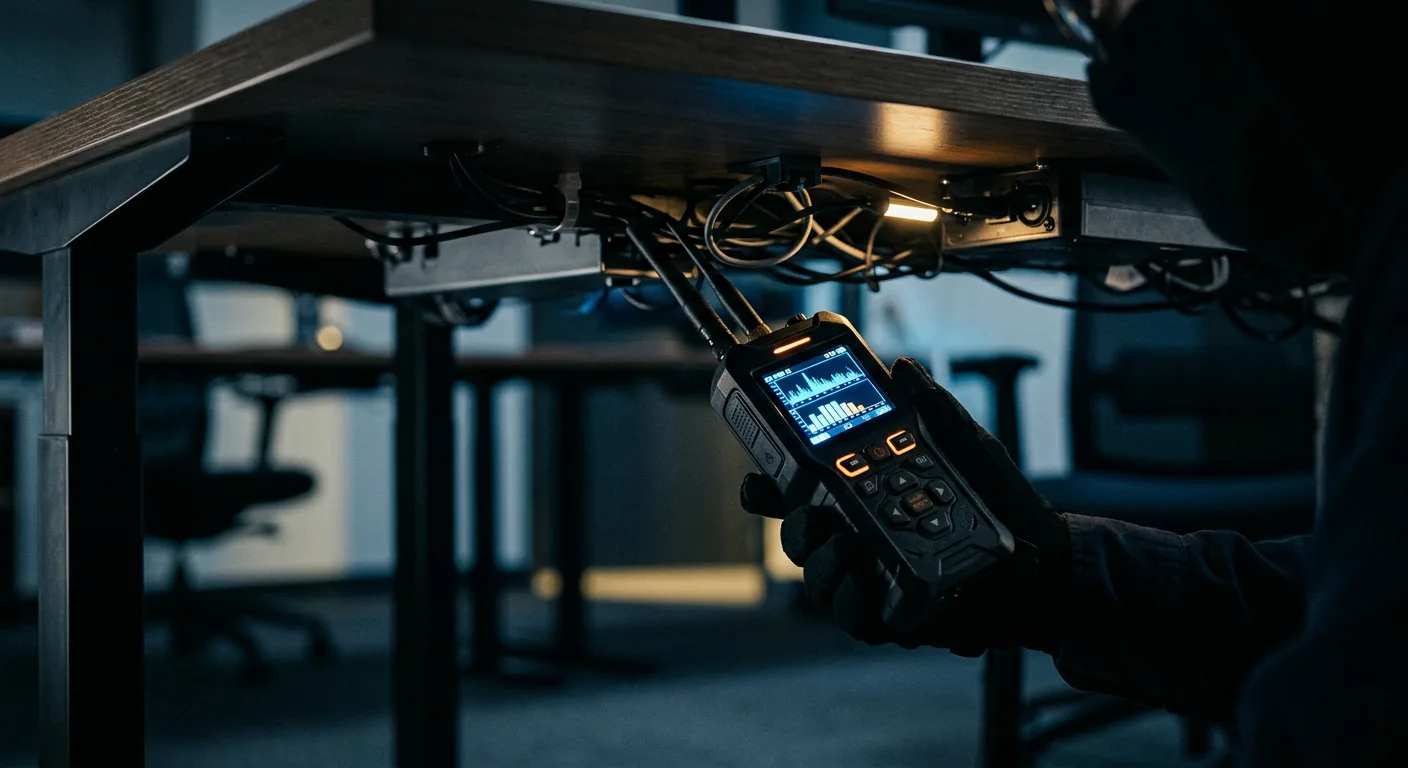
- Turn off your own signals. Wi-Fi router, phones, tablets, smart speakers, Bluetooth headphones. Every one of them will set off the detector.
- Take a baseline. Stand in the middle of the room and note the reading. You are looking for spots that jump above it.
- Make noise. Play music or talk out loud. Many bugs only switch on when they hear sound, so a quiet room can hide them.
- Go slow and close. Hold the detector a few inches from every outlet, fixture, vent and object. Move about a foot every few seconds.
- Track it down. When the reading climbs, turn the sensitivity down and keep closing in until you find the source.
Know the limits. An RF detector cannot see a recorder that sends nothing. It can miss a cellular bug that is not on a call at that moment. And it cannot find a device that is switched off. Pros use a non linear junction detector for that. It finds the electronics inside a wall or a piece of furniture, on or off. Those cost thousands of dollars and take training to use.
Signs You May Be Bugged
One sign means little. Several together are worth taking seriously.
- Someone knows things they should not. Details from a private call, a plan you only said out loud at home. This is the strongest sign by far.
- New objects you did not buy, or familiar ones that were moved, swapped or turned to face a new direction.
- Signs someone was inside. Dust disturbed, ceiling tiles out of place, a door or window you know you locked.
- A person with access and a motive. A partner in a divorce or custody fight, an ex who kept a key, a business rival, an employee on the way out.
- Your phone acting strange. Battery dying fast, running hot when idle, data use you cannot explain.
- Buzzing from speakers. A burst of buzz from a speaker or radio can mean a cellular device nearby is sending. Your own phone does this too, so test with it off.
Myths That Waste Your Time
- “You will hear clicks if your phone is tapped.” Not for decades. Modern spying makes no sound on the line.
- “A bug detector app will find it.” Most read the compass sensor. See above.
- “A $30 detector finds everything.” It finds strong signals that are transmitting right now. That is a small slice of what is out there.
- “Just buy a signal jammer.” Jammers are illegal to use in the United States. They also do nothing against a recorder.
- “If the Wi-Fi scan is clean, I am clean.” It only shows devices on your network. Someone who planted a camera does not need your password.
What to Do If You Find a Hidden Device
What you do in the next ten minutes decides whether you can prove who did it.
- Do not touch it. Fingerprints and the device’s memory are evidence.
- Do not say anything about it out loud. If it is live, the other person hears you find it.
- Photograph it where it sits, from a few angles, with something for scale.
- Leave the room and make calls from outside, on a phone you trust.
- Do not confront anyone yet. If they know, other devices and the recordings disappear.
- Call the police and a professional. A sweep finds out if it is the only one, and a written report helps your lawyer and the police.
Is a Hidden Listening Device Illegal in New York?
Usually, yes. New York is a one party consent state. You may record a conversation you are part of. Recording a conversation you are not part of, without the consent of at least one person in it, is eavesdropping under New York Penal Law 250.05. It is a class E felony.
Hidden cameras have their own law. Secretly recording someone in a bedroom, bathroom, changing room or similar private place is unlawful surveillance under Penal Law 250.45, also a felony. Landlords, roommates and spouses are not exempt.
This is general information, not legal advice. If you find a device, talk to the police and a lawyer before you do anything with it.
Checking a Hotel Room or Airbnb in 5 Minutes
Airbnb banned all indoor security cameras in 2024, wherever they are placed. Hotels do not allow them in rooms either. Still, check:
- Do the lights off infrared sweep with your phone, aimed at the bed and the shower.
- Look closely at the smoke detector, alarm clock, TV and any USB charger already plugged in.
- Check the Wi-Fi device list if you are on the property network.
- Unplug what you do not need, or cover it with a towel.
- If you find a camera, photograph it, leave, and report it to the platform and the police.
When to Call a Professional
The checks above catch careless setups. They will not reliably catch a recorder, a cellular bug, a device inside a wall, or anything switched off. Call a professional when:
- Someone keeps knowing what you said in private.
- You are in a divorce, custody case or business dispute with someone who had access.
- You found one device and need to know if there are more.
- You need a written report for a lawyer, the police or a court.
- You are about to hold a meeting worth spying on.
| What gets checked | You, tonight | A TSCM sweep |
|---|---|---|
| Night vision cameras | Yes, with your phone | Yes |
| Wi-Fi and Bluetooth devices | On your network only | Every signal in the room |
| Cellular bugs | Rarely | Yes, with spectrum analysis |
| Recorders and switched off devices | Only by eye | Yes, with a non linear junction detector |
| Inside walls, ceilings and furniture | No | Yes, plus thermal imaging |
| Phones and accounts | Basic settings | Full review |
| Written report | No | Yes |
In New York, NYIA runs a full TSCM bug sweep for homes, offices and cars for a flat $1,400, with a written report of what was found. See how a TSCM bug sweep works, step by step, and how often you should get one. If you do find something, call us from a phone outside the room you suspect.
How to Keep It From Happening Again
- Control who gets in. Change the locks after a breakup or a bad hire. Know who has keys and codes.
- Lock your phone and accounts. A new passcode, a new Apple or Google password, and two step sign in.
- Change the Wi-Fi password and the router’s admin password, then check the device list once a month.
- Be careful with gifts. Electronics from someone with a motive deserve a close look.
- Sweep on a schedule if your work or your situation makes you a target.
Common Questions
How do I know if my home has a listening device?
Common signs are private details others should not know, odd noise on calls, new items you did not buy, and objects that were moved. One sign proves little. Several together are worth checking. Do not confront anyone first. Consider a professional sweep.
Can a cell phone detect a listening device?
Only some kinds. A phone can spot infrared lights from night vision cameras, unknown Bluetooth devices and unknown devices on your own Wi-Fi. It cannot find voice activated recorders, cellular bugs or anything switched off.
Do bug detector apps work?
Mostly no. Most free apps read the phone’s compass sensor, which reacts to any metal or magnet. Network scanner apps like Fing are useful, but only for devices on your own Wi-Fi.
How far away can a listening device work?
It depends on the type. A cheap radio bug reaches a few hundred feet at most. A Bluetooth bug works across a room or two. A cellular or Wi-Fi device can be listened to from anywhere in the world.
Do hidden cameras make noise?
Almost never. Some night vision cameras make a faint click when they switch between day and night mode, usually around dusk and dawn. Silence does not mean a room is clean.
Is it illegal to put a listening device in someone’s house in New York?
Yes, in almost every case. Recording a conversation you are not part of without anyone’s consent is eavesdropping under New York Penal Law 250.05, a felony. Hidden cameras in private places fall under the unlawful surveillance law, also a felony.
How much does a professional bug sweep cost?
NYIA charges a flat $1,400 for a full TSCM sweep of a home, office or car in New York, with a written report of what was found.
You do not have to handle this alone. A licensed New York private investigator can do the legwork for you. As a discreet private detective agency, NYIA gathers proof that holds up, and every private investigator on our team is fully licensed. Call for a free, private consultation.

David J. Schassler
Emmy® Award Winning Private Investigator · NYS DOS License #11000169770
David founded New York Intelligence Agency in 1989 and has personally directed every major case since. His investigative work earned a New York Emmy® Award. More about David →
Got it. We will be in touch.
Somebody reads this personally. If it is urgent, call (646) 461-4650 any hour.
Free, Confidential Consultation
When you need answers,