TSCM & Bug Sweeps
How to Find a GPS Tracker on Your Car
Author Source EEAT Authors · David's Author Page
Author Source EEAT Authors · David's Author Page

To find a GPS tracker on your car, run your phone's unknown tracker scan first, then search the car by hand with a flashlight. Start with the wheel wells, the bumpers, the frame under the car and the diagnostic port under the dash. A phone only finds Bluetooth tags like an AirTag. It cannot see a cellular GPS box, a wired tracker or a logger that sends nothing, so a clean scan is not a clean car.
13 sections
Like what you read? Show me more from NYIA on Google, then pick us as a preferred source.
We have swept cars, homes and offices across New York since 1989. A lot of our calls come after a phone app said all clear. Below is how to check your own car tonight, where the phone apps stop working, and what to do if you find something.
Before You Search
This is the fastest check, and it is free. It only works on one kind of tracker, so treat it as step one, not the answer.
On an Android phone. Open Settings, tap Safety and emergency, tap Unknown tracker alerts, then tap Scan now. Google says the scan takes about 10 seconds and works on Android 6 and up, per Google's unknown tracker help page. It looks for tags that are not yours, including Apple AirTags. Sit in the car with the engine off and run it twice, once in the front seat and once by the trunk.
On an iPhone. There is no scan button. The iPhone warns you on its own when a tag that is away from its owner seems to travel with you. Apple says that needs iOS 17.5 or later for most trackers, with Bluetooth and Tracking Notifications on and Airplane Mode off, per Apple's unwanted tracking support page. You can see past alerts in the Find My app. Check that list before you do anything else.
Apple's page also names the Tracker Detect app for Android. It looks for tags that work with Apple's Find My network and are away from their owner. Google's built in scan already covers AirTags, so most Android owners can skip the extra app.
If the scan finds a tag, tap Play sound and follow it. If it finds nothing, keep going. You have only ruled out one kind of tracker.
Most tracker guides leave this out. The phone scan listens for Bluetooth tags that were built to report themselves. A tracker made to stay hidden does not do that.
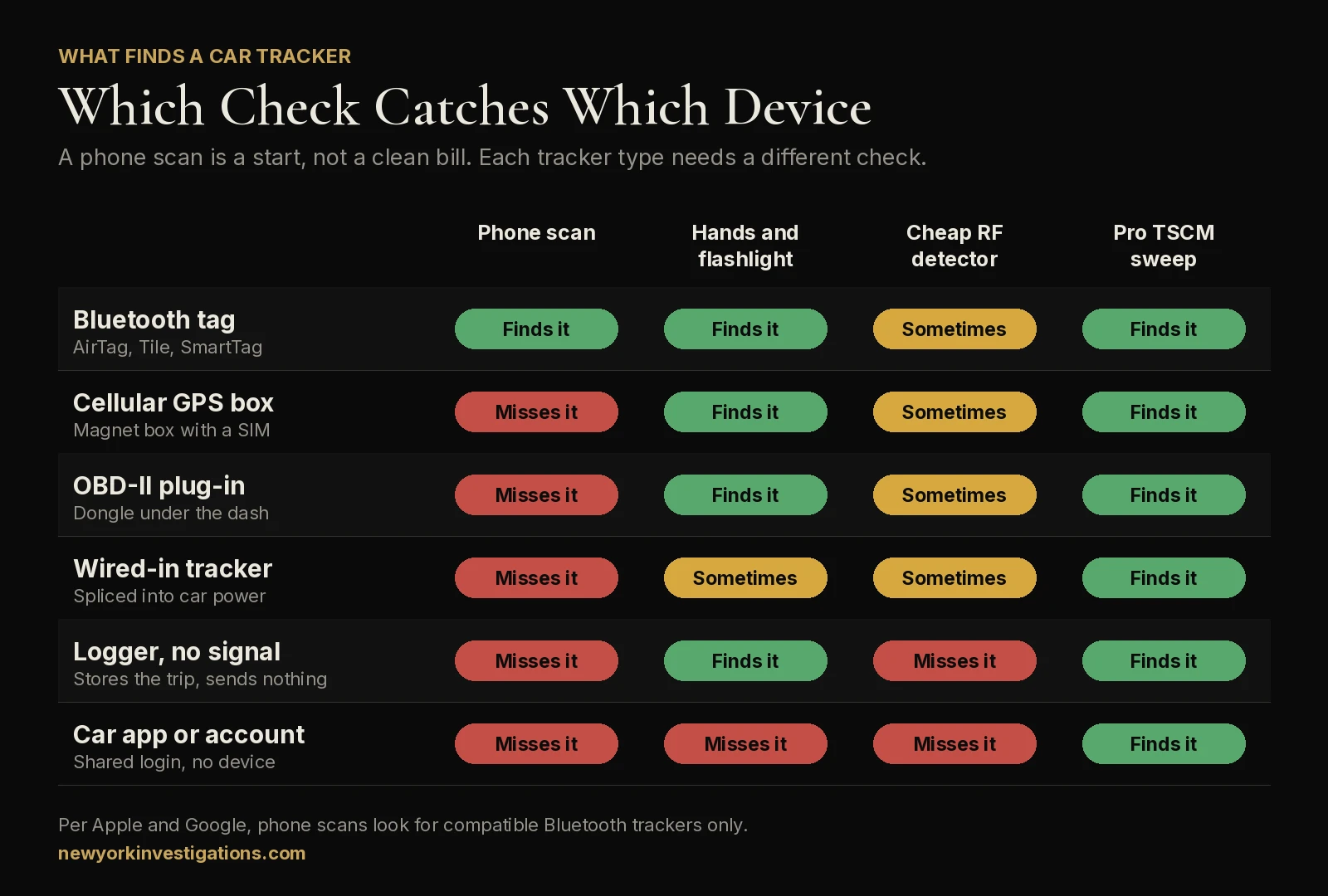
| Tracker type | How it works | Will a phone scan find it? |
|---|---|---|
| Bluetooth tag | An AirTag, Tile or similar tag. It reports through nearby phones. | Yes, if it is a compatible tag. |
| Cellular GPS box | A small black box with a SIM card and a battery. It sends its location over the cell network. | No. |
| OBD-II plug in | Plugs into the diagnostic port under the dash and takes power from the car. | No. |
| Wired in tracker | Spliced into the car's wiring behind a panel. It never runs out of battery. | No. |
| GPS logger | Records where the car goes and sends nothing. Someone comes back to collect it. | No. It gives off no signal at all. |
| Car app or shared login | The car's own app shows its location to anyone signed in to the account. | No. There is no device to find. |
So a phone scan is good news when it finds something and almost no news when it finds nothing. The hand search below is what covers the rest.
A tracker placed in a hurry usually goes on the outside, because the outside does not need a key. A magnet box can go on in seconds while the car sits at the curb. In the city, where most cars live on the street overnight, that is the first place we look.
You need a strong flashlight, a pair of gloves and a mat or old towel to lie on. Do it in daylight, in a safe spot, with the engine off and cool.
| Spot | What to look for |
|---|---|
| All four wheel wells | Run a gloved hand along the top of the plastic liner and the metal lip behind it. Feel for a box that does not belong. |
| Front and rear bumpers | Shine the light up behind the bumper cover. Trackers love the flat metal beam behind it. |
| Frame rails underneath | Lie down and check the long steel rails on both sides. Look for a black or gray box, often with a magnet, sometimes wrapped in tape. |
| Near the rear axle and gas tank | Check flat steel surfaces near the back. Do not touch hot exhaust parts. |
| License plate area | Look behind the plate frame and in the bumper gap around it. |
| Spare tire well | Lift the trunk floor and check around and under the spare. |
Clean metal or a box with no dirt on it, when the rest of the car is grimy, is a tell. So is fresh tape or a zip tie where none should be.
Inside trackers take longer to place, so they usually point to someone who had your keys. That could be a partner, a family member or anyone who borrowed the car.
Be careful with the OBD-II port. Not every plug there is a spy. Insurance discount programs, fleet managers and some dealers use plug in devices too. If you did not put it there and nobody told you about it, photograph it before you touch it.
The fastest way to track a modern car needs no device at all. Many new cars can show their location in the maker's app. If someone set up the app, or still knows the password, they can see where the car is from their couch.
The FTC warns that a phone can carry stalkerware too. Signs include a battery that drains fast, data use you cannot explain, and someone who knows things they should not, per the FTC's stalkerware guide. If the person seems to know where you go even when you take a cab, the problem may be your phone, not your car.
A bug in a car is less common than a tracker, but we do find them. Most are small recorders that save audio and get picked up later, or cellular bugs with a SIM card that someone can call and listen through. Neither shows up on a phone scan.
They hide in the same inside spots as trackers, plus the headliner, the rear view mirror base and behind the radio. Some combined units track and record at once. A cheap radio frequency detector can sometimes pick up a cellular bug while it is sending, but it will miss a recorder that is only saving to a memory card.
Your first move matters more than how fast you get it off the car.
Then think about who has a legal reason to track the car. A lender on a car loan, an employer on a company car or an insurance program you signed up for may have a tracker on it. Ask before you rip anything out.
Usually not, when it is aimed at a person. New York's stalking law counts unauthorized tracking of someone's location with a GPS or other device as a form of following, per Penal Law 120.45. Stalking in the fourth degree is a class B misdemeanor, and the higher degrees are more serious. Recording a conversation you are not part of, with no one's consent, is eavesdropping, a class E felony under Penal Law 250.05.
Who owns the car matters, and so does whose name is on the title. That is a question for a lawyer. What we can tell you is that a licensed investigator will never place a tracker on a car the client has no right to. We explain the limits in how private investigators legally collect evidence in New York.
Some sites sell jammers as the answer. In the US it is illegal to use, sell or market one, and there are no exceptions for personal or vehicle use, per the FCC's jammer enforcement page. A jammer can also block 911 calls, including your own. Find the device instead.
Call a pro when the phone scan and your hand search come up empty but the signs keep adding up. That means someone shows up where they should not, knows where you parked, or brings up trips you never mentioned. It also makes sense in a divorce, a custody fight or a business dispute, where you need a written record of what was found that a lawyer can use.
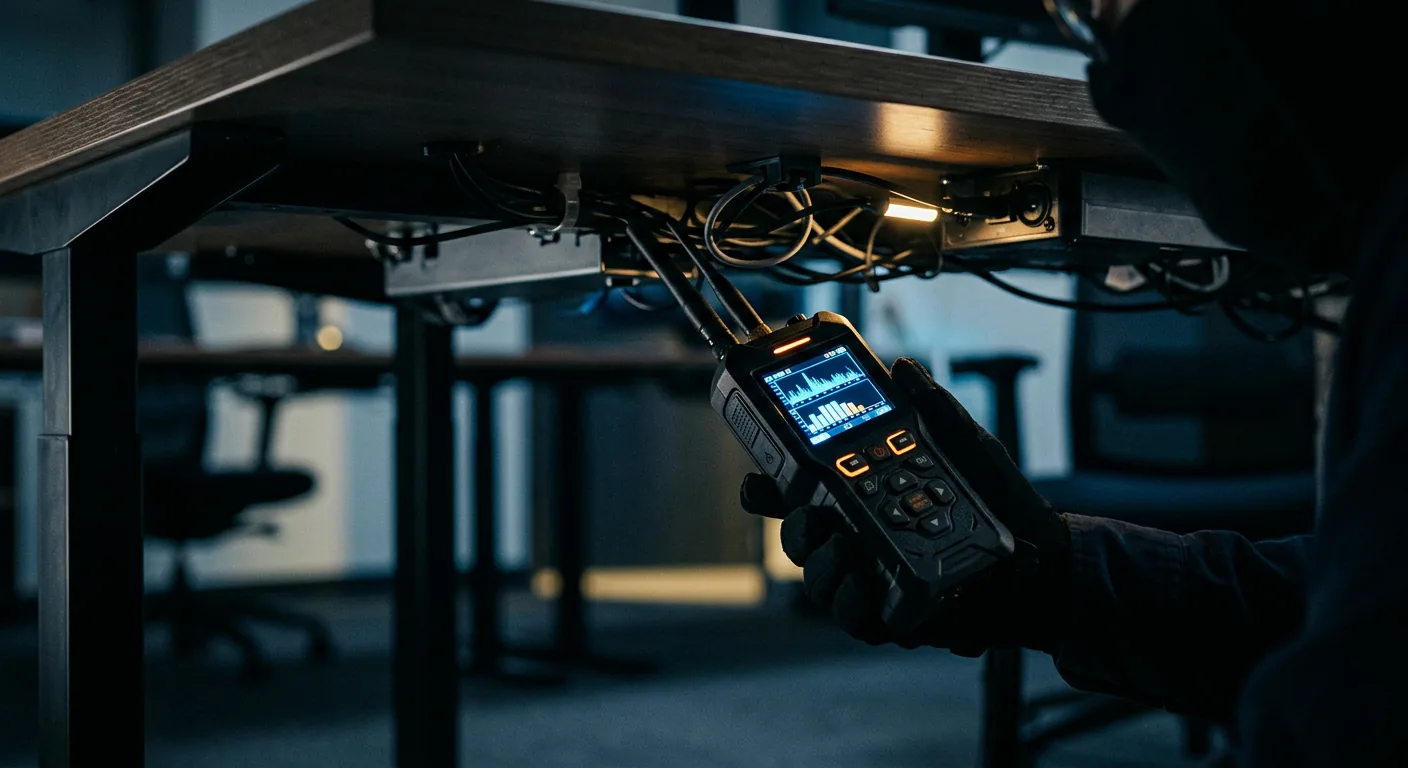
A professional sweep checks every signal around the car, searches the body, interior and wiring by hand, and reviews the phones and accounts tied to it. In New York, NYIA runs a full TSCM bug sweep of a home, office or car for a flat $1,400, with a written report of what was found. See how a TSCM bug sweep works, step by step, or our TSCM and bug sweep service.
If the car is clean and you still feel watched, read signs you are being watched or eavesdropped on, and our guide to finding hidden cameras and listening devices in your home.
Run your phone's unknown tracker scan, then search the wheel wells, bumpers, frame rails, spare tire well and the OBD-II port under the dash with a flashlight. Signs include someone who knows where you parked or brings up trips you never mentioned. A phone scan only finds Bluetooth tags, so a clean scan does not clear the car.
Only some. Android's Scan now and the iPhone's automatic alerts look for compatible Bluetooth tags like AirTags that are away from their owner. They cannot see a cellular GPS box, a wired tracker, a plug in tracker or a logger that sends no signal.
Fast placements go on the outside, held on by a magnet. Look inside the wheel wells, behind the bumpers, along the frame rails and near the rear axle. Someone with your keys may use the OBD-II port, under the seats, the glove box or the trunk trim.
Not right away. Photograph it in place first and write down the date, time and any serial number. Removing it can warn the person watching you. If you feel unsafe, call the police or the National Domestic Violence Hotline at 1-800-799-7233 from a phone the other person cannot reach.
Using a GPS or other device to track a person's location without authorization counts as following under New York's stalking law, Penal Law 120.45. Who owns the car matters, so ask a lawyer about your case.
NYIA charges a flat $1,400 for a full TSCM sweep of a home, office or car in New York, with a written report of what was found.
You do not have to decide anything on the first call. Tell us what you have noticed, and we will tell you plainly whether a sweep makes sense. Call David at (646) 461-4650 any hour, or text (646) 465-2006. If you think your phone is being watched, call from a different phone. You can also contact us online.
Every fact above comes from one of these pages. Check any of them yourself.

David J. Schassler
Emmy® Award Winning Private Investigator · NYS DOS License #11000178595 (New York) and #11000061564 (Haverstraw)
David founded New York Intelligence Agency in 1989 and has personally directed every major case since. His investigative work earned a New York Emmy® Award. More posts by David →
Somebody reads this personally. If it is urgent, call (646) 461-4650 any hour.